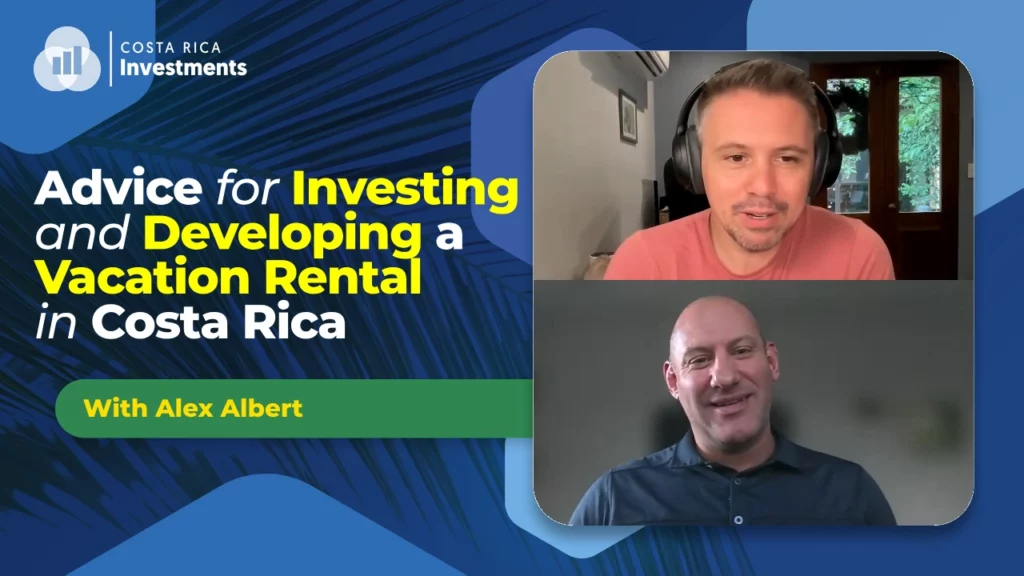
Tourism Volatility in Costa Rica
[Richard Bexon]
Casey, how are you doing?
[Casey Halloran]
Doing good, Richard, how you been?
[Richard Bexon]
Good, man, it’s been a while since we’ve had you here on the podcast, but I think it’s about time. Okay, yeah, ups and downs.
Exactly, I think, yeah. Well, that’s my first question, you know, I always love to ask. I mean, there’s quite a bit of volatility out there at the moment, and I think that’s probably here to stay.
But I mean, what have you been seeing happening in the tourism world?
[Casey Halloran]
Well, hopefully the VIX chart exploding five-year highs isn’t here to stay. But yeah, I think since probably the US election and right up to the tariff tantrum of this week, definitely a lot of volatility, and I think that always just shows up in high-end transactions is people stop and think a little bit. I think that’s kind of what we’re seeing in the market.
And I think what I’m sensing also is after a three-year miracle run, a lot of the seller side, meaning the hotels and whatnot, have been probably a little resistant to reprice. And you know, and it’s also hard in Costa Rica to reprice right now because the exchange rate is so unfavorable. So I think it’s just gonna take a while for people to get used to, dare I say, the new normal.
Yeah.
[Richard Bexon]
So demand down a little bit. What do you think Q1, how much do you think demand’s gonna be down in Q1?
[Casey Halloran]
Overall, when we look backwards, I would say 7, 8%, 7, 8%.
[Richard Bexon]
Okay, so it’s pretty close to what we were predicting at the end of last year anyway.
[Casey Halloran]
Yeah, and again, benchmarking against a three-year miracle run, expecting that to continue feels a little bit greedy. So back to work, you know, Rocky IV, burn sit-ups. I mean, I love- Can you sing a song while I work out in the back?
[Richard Bexon]
I love doing business in those times, to be honest with you. I mean, when it’s all good, I don’t, you know, it’s just, it feels, it doesn’t feel right.
[Casey Halloran]
Look, if I think of Richard Bexon’s happy place, it’s haggling in an Egyptian bazaar. I think for a lot of us, we like a little bit of, you know, bullets and smoke and grenades going off. So if you’re an intermediary who really adds value, when are you gonna really add value?
In tricky times. Oh, I guess my dog’s joining. So I’m excited about it.
I think it’s just, it takes a while for everybody to adjust to, oh, this isn’t easy anymore.
[Richard Bexon]
Yeah, and I think it’s probably gonna take the rest of this year for that.
[Casey Halloran]
You know, I mean- I’d say at least another quarter until everybody readjusts to the fact that there’s probably a significant increase in supply with all the Airbnbs that you and your cohorts have helped build, plus a little bit less demand. So more supply, less demand, you know, we kind of need to, we need a price reset.
[Richard Bexon]
Well, and it’s about time to be honest, because again, there’s some of these prices are absolutely, you know, I mean, I paid last year $250 to stay in a hotel that I know pre-COVID was like a hundred.
[Casey Halloran]
That’s the thing that people have forgotten, right? And again, every now and then I revisit the rate cards of all of our suppliers and some of the stuff so feels a little grabby.
[Richard Bexon]
Well, I did not get that value if that made sense. I did not feel that I got $250 worth. I felt like maybe I got 150 and I was being gouged.
[Casey Halloran]
Well, isn’t that what they say? Price is what you pay, value is what you get. And I do get concerned sometimes specific to Costa Rica that the value proposition may have gotten a little out of whack.
[Richard Bexon]
Yeah, yeah, I agree, I agree. You know, we always talk about like how tourism influences real estate and you have people in tourism on one side and people have the real estate on the other side and they never really talk. How do you think one affects the other?
Tourism and Real Estate in Costa Rica
[Casey Halloran]
I think that they’re probably Siamese twin levels of interconnected, maybe more than we even really understand. Certainly like most folks, I came here on vacation first, you know, like 20, 26 years ago. So the vast majority of your future foreign investors, let’s be honest, that’s a pretty good chunk of who’s moving the luxury market, at least outside of San Jose.
Most of those people came here on vacation. So you come here on vacation, you fall in love with it. You wonder if you could live here.
Then you buy something that’s usually a second home. So when you’re not here, you wanna rent it. And who do you rent it to?
You rent it to tourists. So these things are inextricably tied, at least for now.
[Richard Bexon]
Well, and it’s amazing how people in real estate and development do not speak to tourism and do not look at the tourism data at all. Like they don’t look at any of it, it’s crazy.
[Casey Halloran]
It is fascinating, right? I mean, there certainly are exceptions, right? You have projects that have blended the two, all of your major branded stuff.
You’ve got what, the Four Seasons, the JW Marriott at the Pena, the Westin project at the Clinchow. Los Sueños. Los Sueños Resort.
Geez, now we’re getting to the short list, right? Las Catalinas. It’s not a- Mega developments.
Yeah, I mean, you’ve gotta have some serious bucks to get started. We’ve got a lot of it on the micro level. I think there’s a lot of small hotels that have sold extensions, villas or apart hotels or even managed units.
But yeah, I mean, Costa Rica is not cheap anymore.
[Richard Bexon]
No, no. I mean, I always just say to people, I might look, if you look at hotel data and you look at tourism data, it’s going to tell you where real estate’s going to go. Because if people are willing to spend 1,000, 1,500 bucks a night, and I’ll use our now as an example to go up there and they love it up there, like what’s stopping them from building something or developing something up there?
[Casey Halloran]
Well, it doesn’t have monetization. The monetization of most things, the cash flowing of most things ultimately come back to the room night value. So, I mean, Airbnb changed everything in this front.
I mean, people have just gotten used to the notion of you go, you travel somewhere and certainly if you need two rooms, you’re considering an Airbnb. So then for your typical investor type, your second home income investor type, it became much more of a business decision than necessarily a pure passion play. So, yeah, I mean, if you’re not looking at the data and thinking that everyone’s competing for heads in beds, then you’re delusional.
[Richard Bexon]
Yeah, yeah, I agree. What trends are you seeing currently in Costa Rica that you think are going to shape the future of tourism here? Ooh, let me get my magic eight ball.
I mean, you and I chat about apart hotels.
Tourism Trends and Extended Stays
[Casey Halloran]
Yeah, I don’t even necessarily know that that’s customer driven. I think that it’s more we’re trying to figure out these new capitalization models of tourism development. One trend that I think is here and I hope is here to stay is extended stay travel.
I know you work when you’re traveling. I certainly work when I’m traveling. I think being able to go places and plunk down and go, I’m going to sit here for 10 days but I’m also going to work a little bit.
My wife will work a couple of days. I’ll work a couple of days. I think that’s changing.
So hotels are going to have to get better about having workspaces. Vacation rentals are going to have to get better about having workspaces. I think that’s going to be as big of a request in the future is, you know, do you have a decent gym?
So that’s, I think one. This retreats thing is not going away. And I would almost define that as like theme specific hotels but the theme can change every week.
So you have these TEDx type groups, you know, people who have a following of any sort. Instead of more like internet influencers, you have more like cultural influencers, you know, groups of scientists or doctors or artists who take over properties. I don’t think that’s going away.
Certainly all the wellness stuff, the digital detox. The thing that I think is kind of funny is sort of the adult summer camp vibe. I’m sure somebody has come up with a better name for that but I think some of these retreats kind of cater to that.
The people who want to regress to a simpler time, never to a simpler time. So I think there’s just more niches than ever. Maybe farm to table, volunteering, conservation but I’m really into the longer stays thing.
I really hope Westerners decide that you can vacation more and it doesn’t have to be purely vacation time. Like don’t just come down for five nights, come down for 10 and work a couple. It can be that.
[Richard Bexon]
I agree. What’s your, you know, because I mean, we’re pushing heavy on our side, you know, into these vacation rentals with hotel amenities, this blend between the two. You think that that’s something that’s here to stay or that like, I know the country needs it more.
[Casey Halloran]
I mean, I guess the real question sort of in the channel analogy would be who’s going to figure it out first? Are the real estate guys going to figure out how to be hoteliers? Are the hoteliers going to figure out how to be real estate guys?
And gals, of course. So if you’re purely developing spec homes somewhere, you better have a hospitality piece, like a real one. And if you’re going to build a 600 room resort, you’d better have some real estate for sale.
So I think the lines between these entities is going to get blurred. And for the ones who don’t know the other side of the game, you better subcontract that or go hire that expertise. But this is what everybody wants and expects.
And geez, I mean, when you rent a six bedroom villa in Costa Rica and you drop $50,000 over a Christmas or New Year’s, you expect to dial zero and get service. Correct, or have someone there full time. Yeah, you’re not, you’re only dazzled by the Florida ceiling windows for the first couple of hours.
After that, you want service.
[Richard Bexon]
Yeah, yeah, I agree, I agree. So, I mean, what advice would you give? I mean, a lot of people out there, of course, just bought vacation rentals or hotels.
You spend a lot of time speaking to people with hotels. That’s just the tourism industry. I mean, what advice would you give to people based on current market conditions on making sure that their product’s at the forefront, how to market it, like what not to do?
Because it’s going to, I mean, if demand is seven, 8% down and supply still continues to grow, I mean, this could become very tricky.
Revenue Management and Distribution Strategies
[Casey Halloran]
Well, and then you don’t forget the other part, exchange rate. So everybody’s cost basis now, at least in Costa Rica, is tougher than ever. So you have a pretty hard floor on what you can charge.
That’s unique. Back in the old days, you could slash your rates down to 99 bucks a night and still survive. But boy, I mean, what’s inflation been down here over the last two, three years, 40%?
[Richard Bexon]
I mean, yeah, probably. I mean, that’s just the exchange rate. We’re not talking about the cost of goods, of course.
That’s just exchange rate.
[Casey Halloran]
Yeah, so you probably all baked in maybe 50% increase in 36 months. I mean, that’s nuts. And that shows no sign of relenting.
So I’d say, number one, you better know your numbers. Like you need to know your cost structure. You need to know your breakeven.
You need to know your competitor numbers. You need to understand the basics of revenue management, which I think a lot of folks don’t. And I think a lot of folks misuse revenue management.
And then second, as far as distribution goes, I’m biased because I’m a marketer and a travel agency, but you’d better be omnichannel. And by that, I mean, you need to know every single distribution method and use them all. And now the channel management tools, even for small properties and individual vacationals, they’re good.
So you should be distributing your inventory to everybody you can. And you should be dialing your rates up and down on occasion to meet demand.
[Richard Bexon]
Yeah. Yeah. I mean, it’s amazing that you say channel manager and the property management, and we just installed one.
You know what I mean? We’re already managing like four or five properties at the moment. We’ve just went through the whole process there and opening those channels up, whether that be to you guys, direct, Airbnb’s, VRBO’s, you know, et cetera.
[Casey Halloran]
And there’s a sweet spot, right? And you can probably also fiddle with it too much or like over-optimized, I would assume.
[Richard Bexon]
Yeah. Yeah. You know, like the OTAs, use them more last minute, you know, because it’s more of a lower quality of client than it is that you would get direct or through the agencies.
But it just amazes me, case of just like how people forget about the agency business in Costa Rica. Like it’s all OTAs, OTAs, OTAs, and just forget how big that industry is.
Role of Travel Agencies and Luxury Channels
[Casey Halloran]
Rich, it didn’t, because that’s never really been my world, even though that’s a significant part of our business and growing. I didn’t really, really understand it until I went to the Virtuoso show in Vegas and they had four major resorts filled. The main ballroom, they had, you know, all three ballrooms with the walls taken out.
You’re talking about, I don’t know what, 10,000 agents, luxury agents from one consortium that all descends on Vegas once a year. And just that group might be 10% of the trade. I mean, you’re talking about billions and billions of dollars of transactions that particularly at the high end are really being decided by humans.
So while it’s very easy to fall in love with technology and the direct to consumer through whatever channel, the really, really high end taste-making is happening one client at a time.
[Richard Bexon]
Yeah.
[Casey Halloran]
And I was ignorant to that.
[Richard Bexon]
Well, and I think that’s just part of the industry that’s kind of ignored, if that makes sense, because it is a one-to-one thing, but like, it’s a relationship-based business. And like, I, you know, I mean, I do some consulting to property management companies because, you know, and you know them, where I’m like, guys, you need to be connected into the travel industry. It’s a huge part of the business here.
[Casey Halloran]
You know, it’s just- It’s an ocean, Richard. It’s an absolute ocean. And you kind of need a good sea captain.
Yep. And those are your trade representatives. And there’s a good dozen of those who really understand and know Costa Rica, who go to these trade shows on your behalf, or talk to the press on your behalf, or go visit travel agencies on your behalf.
But it’s an ocean, man. It is so, so big.
[Richard Bexon]
What do you think is, what product do you think Costa Rica needs more of? I mean, we’ve got enough villas, you know, we’ve got enough kind of just regular hotel rooms. I mean, what do you think the client is, might be asking for, or stuff that you’ve seen where you’re like, that’s pretty cool.
I think there needs to be more of that in Costa Rica.
Product Gaps and Affordable Lodging
[Casey Halloran]
Unfortunately, I think because of the market conditions in the last few years, meaning the exchange rate and whatnot, everybody seems to have all gone for the six star traveler. And I completely get it. Like, why not?
But I think it’s kind of come at the detriment of the entry level traveler, who in three to five years comes back with some more money, or comes back with their parents. I think we’ve almost priced out, say, your honeymooner. You know, somebody in their late 20s, early 30s, who’s just getting started out.
I don’t know where they would stay here now. So I really think we need more cabins, Airbnbs in funky places. We need places for your entry level tourists who can come down and have an awesome time.
Dare I even say more of your European or Canadian style traveler who’s gonna come down for two weeks. But you know, just one level, we need a level above hosteling that someone figures out the economics. And I realize what I’m asking for is tough, but- Well, it can be done.
[Richard Bexon]
Containers.
[Casey Halloran]
If you’re 90% occupied at a reasonably good rate, and your rooms are simple and small, but good, I think there’s market for that here now. And again, I feel bad for these millennials and Gen Zs or whoever’s all after that. Like, you can’t come here now.
[Richard Bexon]
Yeah, yeah, yeah. Yeah, I mean, it’s domes, it’s containers, it’s tents, it’s yurt. Like it’s that quick- And those folks love that, right?
[Casey Halloran]
And the nice thing about those less permanent structures, let’s call them, the owner can change their mind. They can take them down, they can move them, they can upgrade them later, they can make permanent structures. But I think, and you kind of see the individual micro hotelier, you know, your guy with three Airbnbs, I think they’re figuring it out and filling this gap.
But I think we’re gonna need more glamping, you know, in glamping plus, maybe simple cabins, all over Costa Rica in more affordable places, or maybe more Ticos who’ve sat on family land. We need more options for people who don’t have $350 a night.
[Richard Bexon]
Yeah, I agree, I agree. What are the areas of Costa Rica that you think still have untapped potential when it comes to, I’m gonna say tourism rather than real estate, because again, if tourism drives real estate, then tourism comes first. What are the areas where you’re just like, I think this might be a goldmine?
Emerging Regions in Costa Rica
[Casey Halloran]
Well, that Northern zone, where you’re starting to see like Toku tent camp, that the Hamilton family just completed up there. You know, they’re no dummies. They know what they’re doing.
And I think, I just sense that thing’s gonna go well. Origins that’s up there, I think is ultimately gonna do well. So I think that the Northern zone up towards Nicaragua, big, beautiful, lots of land, not that expensive, close enough to the Liberia airport.
The Southern Nicoya, those, you know, the lesser explored parts of Nicoya. You and I both love Marbella and everything around there, even though it’s tricky heading back up to that mountain, mountainside and that ridge still seems like it has lots of potential. But you know, now you’re basically stuff that caters to surfers with money.
[Richard Bexon]
Yeah.
[Casey Halloran]
I think we have this weird connotation that surfers are all broke, but I think there’s plenty of tech bros who pine for the days when they were 19 and there was nobody else around. So I think finding those secret spots and catering to them is always gonna do well. I’m completely biased that the central Cordillera Central, you know, the central mountain chain still needs more stuff.
[Richard Bexon]
Yeah, I agree.
[Casey Halloran]
I think we need more mountain stuff to go with all these beaches. And right now you’re really just talking about Monteverde and Arenal La Fortuna. I think we need a couple more.
Those would be the places that I would look if I wanted to sort of like take a punt.
[Richard Bexon]
Yeah.
[Casey Halloran]
Would there be any areas that you’d just avoid at the moment? Anywhere that’s building condo towers. I think once you start to get into condo tower zone and institutional investment starts to flood in, there’s always a potential for the bottom to fall out.
And I don’t just mean on the resale market, I also mean on that nightly rate market.
[Richard Bexon]
Yeah, I mean, that’s my concern for HACO.
[Casey Halloran]
Yep, and I think there’s a slight danger there in parts of Tamarindo, as soon as the cranes start going up, then you’re in trouble.
[Richard Bexon]
Yeah, definitely. Okay, so this has been great. My last question for you that I’d love to ask everyone, if you inherited $500,000 and you had to invest it into a business or real estate in Costa Rica, what would you invest it in and why?
Investment Strategy and Final Thoughts
[Casey Halloran]
I think right now I would probably remain asset light. I don’t think I would buy anything because everything’s so expensive right now. I think I would probably focus more on some sort of emerging technology, maybe something AI, maybe something data analytics that focuses on revenue management or rate maximization for property management, for vacation rentals.
So I would look in something to service, maybe somebody who’s got five vacation rentals is like, oh no, what have I done? But staying in that intellectual digital space. And then once you’ve mastered that and you’ve found some maybe gaps in the data, maybe then you go and invest in a little Airbnb somewhere that’s underserviced.
[Richard Bexon]
Well, I mean, just the amount of data that you could gather, as you mentioned there from doing that, but also is just interconnecting, as you mentioned there, that luxury market of like, there is no connection in there. Like you have to physically go and know people if that makes sense.
[Casey Halloran]
It’s wild, right? Yeah. So I see, I mean, look, if it’s true that information’s into the new oil, the oil field down here is in that weird place we keep talking about where real estate overlaps with tourism and then trying to see if there are some, if there’s some data to be arbitraged.
There’s some gaps in there somewhere. There’s something somebody is not seeing.
[Richard Bexon]
Yeah. I agree a hundred percent. Okay.
It’s been an absolute pleasure having you on the podcast. Appreciate you taking the time to join us and share your experience and knowledge with us. And yeah, thanks very much, buddy.
[Casey Halloran]
Thanks Richard. Always a pleasure chatting.
[Richard Bexon]
No worries. Bye.